
Seeing a scale chart at first might look like staring at a map of minesweeper, but, really, it’s not as scary. This, unlike minesweeper, can make sense!
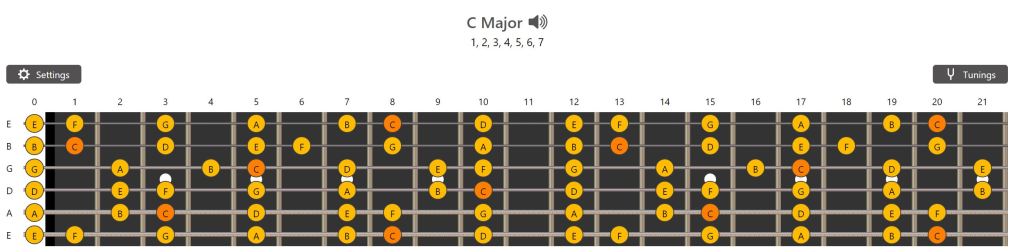
Just looking at this gives you a wealth of information, with the understanding of a scale, you can understand the harmony of chords based on the scale. In it we see the Key the scale is in, we see the Scale Degrees for the “scale type”, and, taking the most space, the actual chart you want to look at.
Starting from the top, we see the chart is identified as a C major scale (sometimes might be written in various ways “C Maj”, “C Mj” or just the letter itself) In this case we go in knowing that the root note of the scale is C.
Then we see the scale degrees, the part with the numbers. Relative to the root of C, major follows the pattern of only using natural notes. It follows C, D, E, F, G, A, B, which is symbolized by the regular numbers there. C=1, D=2, E=3, F=4, G=5, A=6, B=7 It shows the natural form of the scale.
Finally we see the chart itself at the bottom. That actually shows all the possibilities of how to execute the scale. It also has the tuning, since a changed tuning changes the note’s position. Do you want to start from the lowest or highest C you can? And when specifically thinking in terms of stringed instruments, other factors come up. Do you want to run through it with just one string? Maybe over 2? Most instruments can hit a note in only one position/key (whether a trumpet, or a piano, the C4 you want to hit can only ring out when you execute it correctly through the piano key or trumpet valves (with mouth tightness)) On the guitar, the lowest C is the middle C (C4), on bass guitar it is C3, an octave lower. The range of the bass hits the lower registers, that’s why it’s called the bass guitar and uses the bass clef while guitar, starting with middle C, has you working in the treble range/clef. Their range is different, but their shapes remain, just take off the higher strings.
So technically, there’s the bass guitar and the treble guitar…
So How do We Start Reading It?
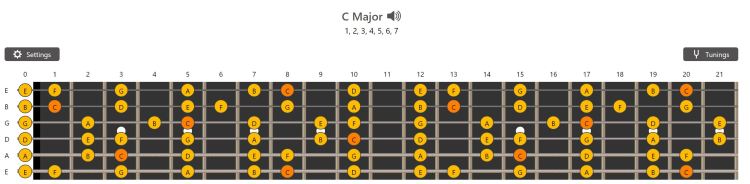
Up in the top is the image that is, but as a musician reading it, you need to see it as a roadmap of streets that you need to connect to get where you want to go. The pattern we follow, no matter where we position our end and beginning, needs to have C, D, E, F, G, A, and B in sequential order (we’re learning scales, not writing songs yet, it’s like learning to draw shapes correctly before you make an image you want later on, the core fundamental can help your technique and composition). We want to start on the C and end on the next one. This concept is about the octaves. The lowest C (root of the scale) is a C4, we want to end on the next one C5. The difference between the 2 is an octave. That’s why there are multiples of each letter throughout the fretboard. There’s multiple Cs (which are darkened in the image) but their octaves are different (though there are duplicates, which is discussed in the next section)
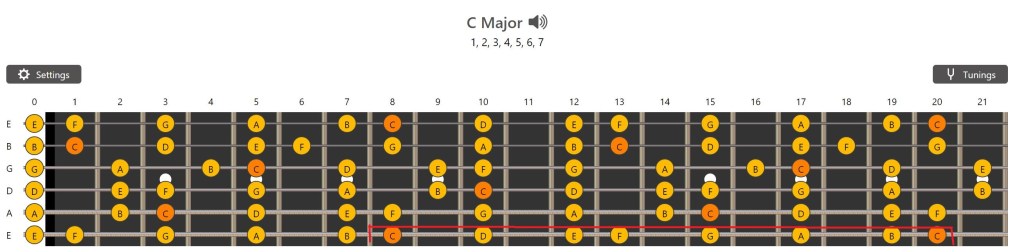
In the image we have an approach to play the C Major. That first C is C4 (knowing the number is good to know but not integral, you can just know it as the lowest C)
Tabbed out it’s:
e----------------------------------
B----------------------------------
G----------------------------------
D----------------------------------
A----------------------------------
E-8-10-12-13-15-17-19-20-----------
  C D  E  F  G  A  B |C
That seems Easy…
Yes it does, but since we are working with stringed instruments, that C4 we’re starting off with has another place to be hit. In a standard based tuning (E standard, D standard etc.), the same note can be hit on the next string, just 5 frets down (with the exception being with 4 frets between G and B strings.) That note duplication is what can make standard notation ambiguous for a person learning a fretted instrument, it’s why I favored learning tabs
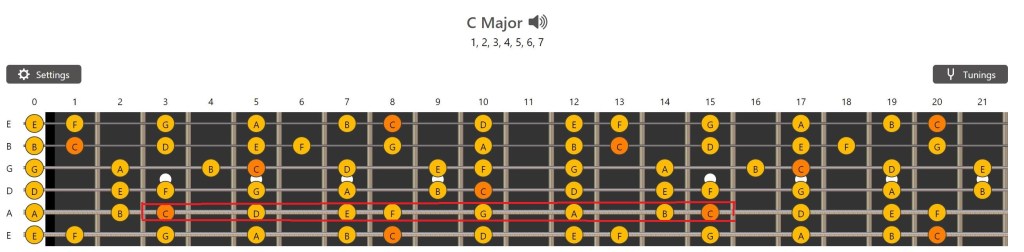
We are still going through the C major, and hitting the exact same notes. The 3rd fret on the A string is C4, and so is the 8th fret in the low E (where we were in the previous run.) Both end on C5, and each note in between is the same pitch too.
e----------------------------------
B----------------------------------
G----------------------------------
D----------------------------------
A-3-5-7-8-10-12-14-15--------------
E----------------------------------
  C D E F G  A  B |C
Both variations together:
e----------------------------------
B----------------------------------
G----------------------------------
D----------------------------------
A-3-5--7--8--10-12-14-15-----------
E-8-10-12-13-15-17-19-20-----------
  C D  E  F  G  A  B |C
These are the exact same notes and pitches
Why would someone choose to hit particular notes on particular strings? Well even though you’re hitting the same exact note, different string affect the sound waves around the note. The higher strings have a a higher end tone compared to hitting the high note on the low string. It’s the same note but it’ll have more bass in the tone of the note hitting it on the thicker strings
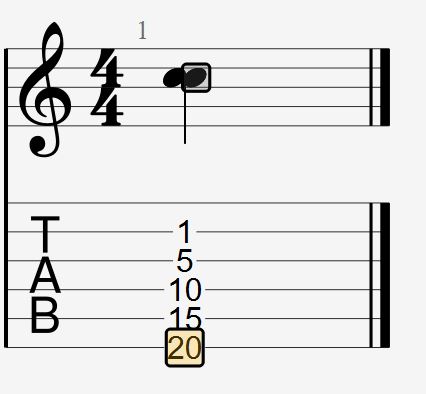
Right above is C5 on 5 different strings. According to the computer it’s the same note, but in our ears, the variances of EQ will stand out. And if your hand can play this, your superhuman-ness will certainly stand out
Why Are We Doing it One String? That’s silly
Yea it kinda is, and isn’t the way I would approach learning scales. I just wanted to show the basic pattern of the scale. With the understanding of note duplication, you can reorientate the scale to go over several strings.
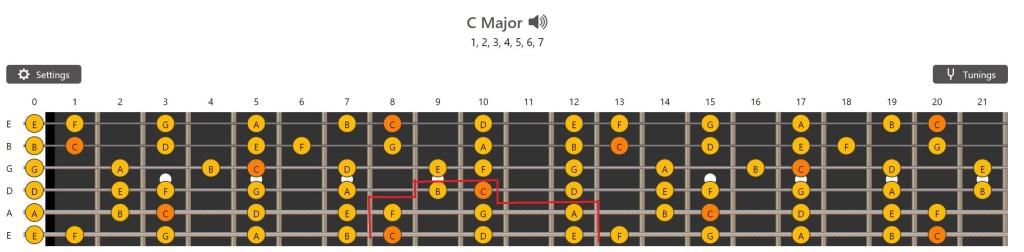
Instead of going over one string, it was transformed to going over 3 strings
e----------------------------------
B----------------------------------
G----------------------------------
D-----------------9-10-------------
A---------8-10-12------------------
E-8-10-12--------------------------
  C  D E  F G  A  B|C
Since we have 6 strings, I like to create a shape that will go through as much and many times as we can through the scale
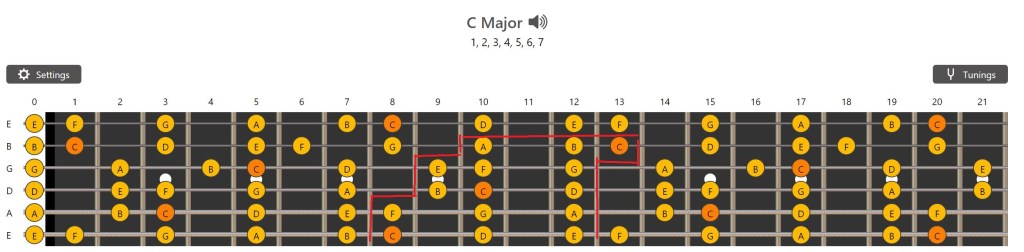
This shape lets you start and end on the C
Tabbed out it’s
e------------------------------------------
B---------------------------------10-12-13-
G-------------------------9-10-12----------
D-----------------9-10-12------------------
A---------8-10-12--------------------------
E-8-10-12----------------------------------
  C  D E  F G  A  B|C  D  E  F  G A  B |C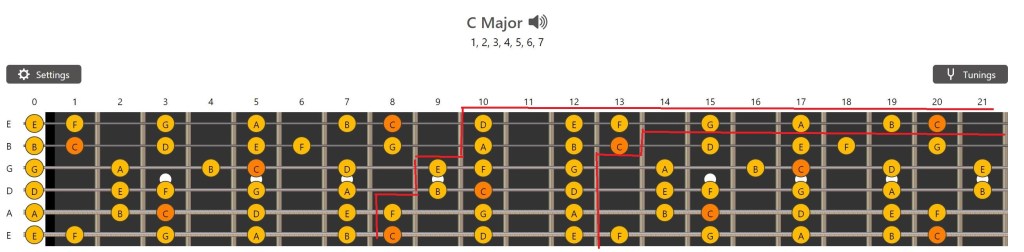
Lets Try Another Scale!
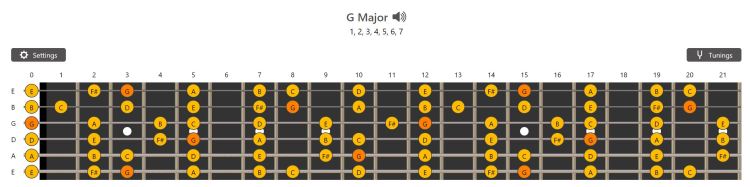
This follows the exact same principle, look for a root to start off with and run the options until you hit the next octave and you have a scale planned out.
Something you may notice is that there is an F# in the scale. Earlier I said all the notes in C Major are natural notes, I didn’t lie. In between each note in the C major the same “distance” is followed (by distance I mean the steps/gap between the notes. Since guitar has steps expressed on the fretboard, it can be thought of as such) What I mean is that the scale degrees defines the major pattern, where the pattern applies tells you the key. Sounds SUPER trippy, but what I mean is just what’s below:
C Major C, D, E, F, G, A, and B
        C, C#, D, D#, E, F, F#, G, G#, A, A#, B,
G major G, A, B, C, D, E, and F♯
        G, G#, A, A#, B, C, C#, D, D#, E, F, F#,
This pattern, shown in the diagram above, can be thought as showing its “musical”/theoretical layout. From their respective roots, they skip the first next note and hit the following one. Comparing the C and the G parallel shows their pattern through the chromatic notes. The crossed out ones are not in the scale.
In the next couple of images, you’ll see it on the fretboard.
What did I get?
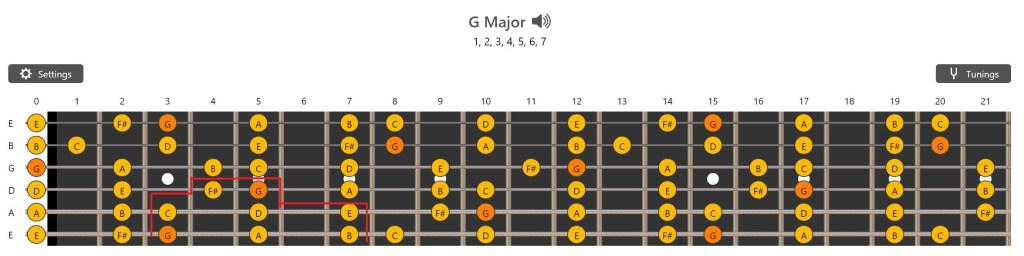
SO you may have noticed a shape come out of both. If you didn’t check this out
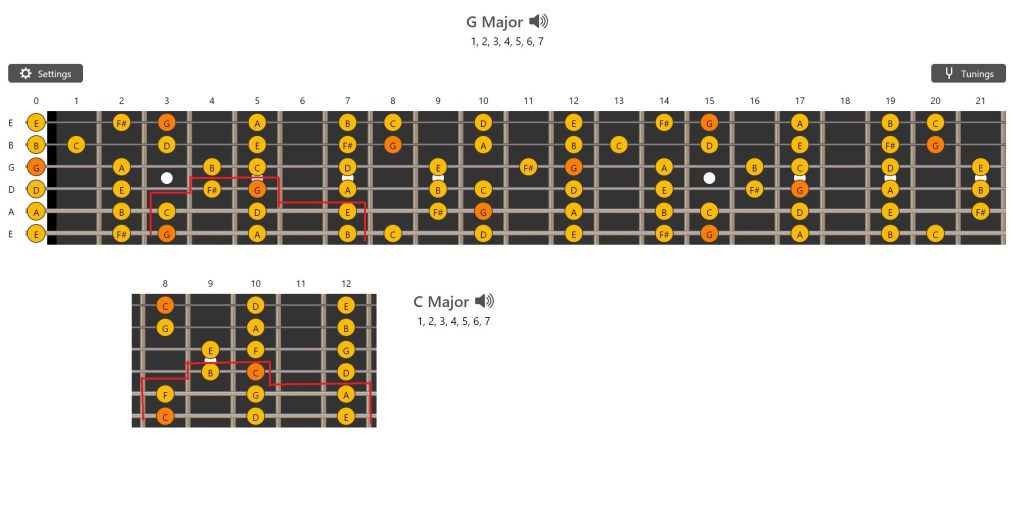
I put in both scales and the shapes around my “chosen path” are the same. The same shape applies to all major scales, the G major shape can follow the C and also follows the F# major. The shape can be brought to each root. Wanna use the shape on the lowest F#? It’ll work starting off on the second fret low E string.
Relative Scales
So the first scale we learned was C Major, and it was comprised of C, D, E, F, G, A, and B. So what if you want to go through the “cycle”/pattern of the C major, but you want to start with A? In that case you’d get A, B C, D, E, F, and G. Just because you followed the pattern of C major, only starting from A, it does not mean that it’s an A Major scale. A Major actually is A, B, C♯, D, E, F♯, and G♯, oh no we got some sharps in there. The scale that is defined by the pattern of A, B C, D, E, F, and G is the A Natural Minor (Usually it’ll be written simply as A Minor.)
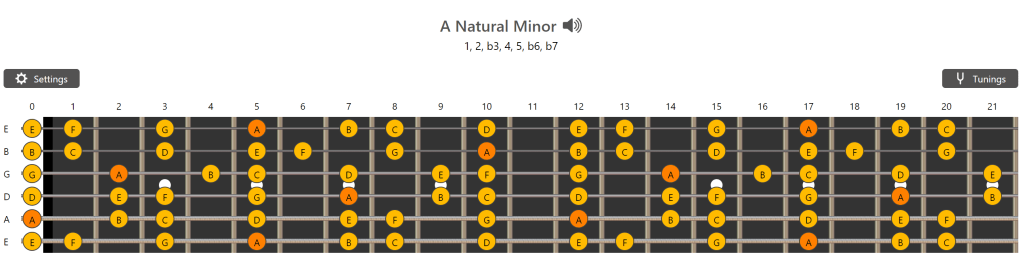
You read them both the same, the difference is in where the root is. Every major scale has a relative scale as a minor scale. Their options are within each other. Their root notes help you orient your playing and can get your brain into habits that didn’t really connect that you’re approaching relatively similar scales differently.
Are Shapes set In Stone?
Nah, the shape helps you get an idea of what you want, but how you branch off the core lets you make something overall that is your way. It will help you be comfortable with the scale around the fretboard when you manipulate the shape. A scale is a scale as long as it hits the notes, where they’re hit does not matter, so long as there isn’t jumping of octaves. By clinical definition, the scale needs the notes sequentially and within range, but when making music you can go in with an understanding of the pattern and jump around octaves and make your fun.
Sometimes having a blank canvas with nothing in mind can be scary, just starting off with a scale can help you narrow a concept down, or at least get you started making something. If you want to make something “simply”, try restricting yourself to only using the notes defined in the scale. Ever heard of Symphony #__ in the key of ___? Composers would sometimes write songs around the scale, sometimes not entirely but it’s the focal point of the piece. We’re not trying to compose for an elaborate symphony, we just want some organized sound with defined notes to start off with.
So get on to making something cool and pushing the boundaries of what you can do with the knowledge you have!
Coming Soon
The relationship between chord shapes and scale charts
 Bodacious Music
2 thoughts on “Reading Scale Charts (Guitar)”