
Example
[Intro]
e|--------------------------------------|
B|--------------------------------------|
G|--------------------------------------|(x3)
D|--------------------------------------|
A|-----4----5----4----2-------2---------|
E|-2-2---2----2----2----5-4-5---5--4--0-|
The top example of this lesson is based on Crazy Train by Ozzy Osbourne (Full Tabs, VIDEO Live Version).
Overview
The way to internalize the layout of tablature is to think of it as a timeline of different locations and events that happen along a unified stretch of time. Maybe the line is referencing events occurring in location A, B and C and at certain times there only events in one of the locations, or there can be multiple events at the same time in different locations. In terms of tablature, the different locations are each string. The events are the note strikes of the song themselves. And the unified stretch of time is the length of the song.
Tuning
The letters on the start of each line of the hyphens represents the tuning of each string. Tuning can be known as the coordination of your string pitch on open notes on each string. Open Notes mean to say that you are not holding down any frets, but are instead letting the string ring “openly”, signified with number 0 in tablature. In this case, this is an E standard tuned song as EADGBe. The lowest line represents your lowest string (may sometimes be considered the 1st for some, but for me, I’ve known it as the 6th) the low E (it’s with a distinction to say the “low” E since there are two of the “same” notes in different octaves. This one is at the pitch of E2) Then going up the notes is the 5th string which is an A (A2). Followed by the 4th string signifying the D (D3). Then the 3rd string, G (G3). Almost done at the 2nd string, B (B3). Finally the 1st string E (E4).
Frets are informally known as the spaces in between the metal (silver bars), but is actually the metal itself. As discussed earlier, 0 is the open string, but the first “open space” is the first fret. From then on, each space is the next fret number.
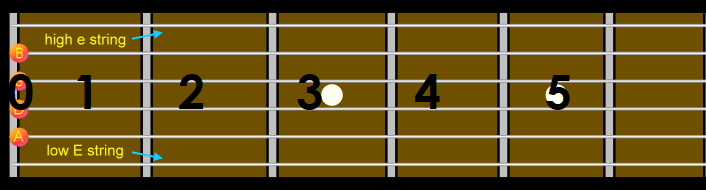
After that, you can do a lot of fun stuff by just only knowing the tunings at first, then learning your favorite songs. Though soon it would be to your benefit to try alternate tunings to give you a different “view” of the instrument and could inspire you to do things you wouldn’t be able to, or would normally, play. Also much to your benefit would be to understand and develop an understanding of the theory with why “it works” the way the songs were written out, and learn to write some stuff you’ll enjoy hearing and playing of your own!
Reading It
[Intro]
e|--------------------------------------|
B|--------------------------------------|
G|--------------------------------------|(x3)
D|--------------------------------------|
A|-----4----5----4----2-------2---------|
E|-2-2---2----2----2----5-4-5---5--4--0-|
So on to the reading of it. Reading from left to right, and reading the lowest line as the lowest open string, you’ll see the first note is 2 on the 6th/E line (string). Every other string has nothing going on, so it’s a single note. The 2 is the numbered fret to hit on the string, this helps picturing the guitar neck as a grid like a chessboard, in this case it’s not just the ABCs (like the C3 space and other coordinated on the chessboard) but the string note (or number) to the noted fret. Continuing on, the tab gives the note again (2nd fret on the 6th/E string). Followed by the 4th fret on the 5th/A string, back to the 2nd on the low E, 5th fret on the A string, and so forth. The 3X just means to repeat the section for 3 times total.
Now, if you’re familiar with song you can already imagine how the rhythm of the song is to learn it on the tablature alone. However, if you have not heard the song you may be confused on the timing of the song by just checking out the tab on its own.
Down below is a more robust and informative way of displaying the tablature. It has more information due to the lines below the fret numbers. This kind of layout combines standard notation and tablature.
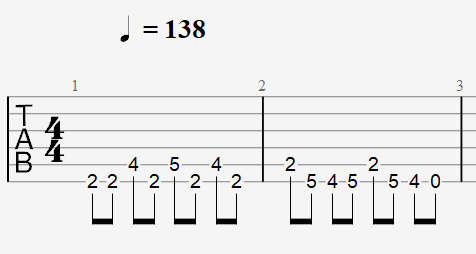
You must understand the basics of standard notation to read this effectively, though you don’t need a deep understanding for reading this well. You must know the signification of whole notes, half notes, quarter notes, eighth notes and and so on connecting to the note, and understand tempo to get the most out of what’s in the image representation of the tablature. The tempo is the number on the top left, so the song follows 138bpm. (Click ‘this’ for more info on standard notation: THIS) This is a relatively simple intro since every note length is eighth notes straight through it.
Another Example (With Chords)
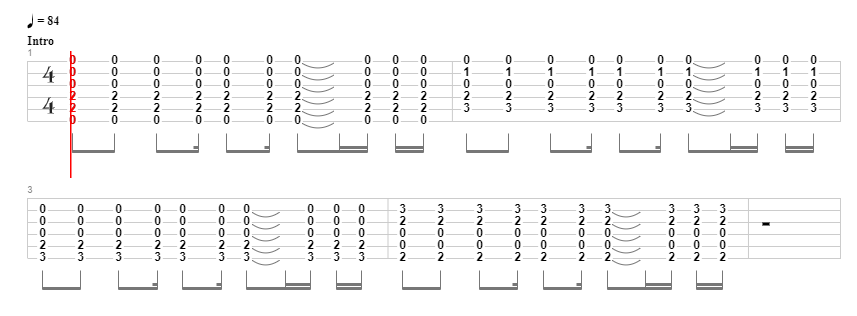
The next example shows chords for the song, which is Zombie by the Cranberries. You see, first off, the song follows a tempo of 84 bpm, and instead of single notes it’ll be chords (Chords are just any more than one note played at the same time. You can learn more about chords HERE) for this section. You see that unlike the previous song, which had only eighth notes one-by-one, this one includes sixteenth notes in chords, which mean their value in time is less/quicker, and that you’ll be strumming. The single line ___ ( which represents ♪ and ♫) means it’s an eighth note and the doubled lines == (𝅘𝅥𝅯 and ♬) note that it’s a sixteenth note. The more lines, the shorter the note.
That red line in the beginning is a visual representation of a moment in time (certain programs, like guitar pro, will play the tablature and every track follows the red line.) This means you will need to play all six strings at once, with your fingers on 2nd frets of the A and D strings and so forth, and strumming your chords through the song.
Example of Playing With “Live Tabs”
All the tabs shown before are in a “static” state, which I mean to say that it’s just read and followed by your eyes, at your own pace. Here is playing along with the actual track. Follow that line to let you know where you are, what’s coming up next, and how soon (tempo). Learn more about how to read these kinds of stuff HERE.
 Bodacious Music
2 thoughts on “Reading Tablature (Tabs)”