
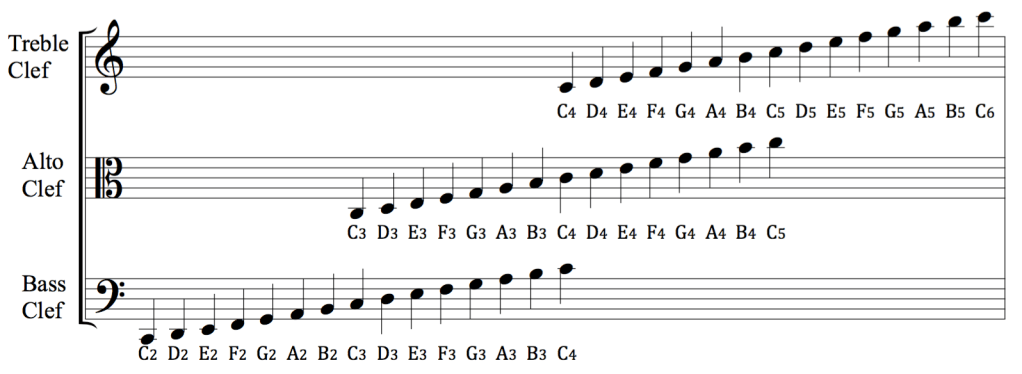
Standard notation is the “written language” of music. You may realize that you can’t reach all the same notes on guitar on the bass (though there are people using extended range guitars like 8 or 9 to 18(!) strings which get them closer or passed it..) Same with a trumpet and tuba, which is why there are different Clefs for their respective ranges.
Something to note is that you may see the overlap relative to the Alto clef and the bass, and the alto and the treble. From C3 to C4 the alto shares with the bass range, then from C4 to C5 the alto shares with the treble. The C4 is shared by all 3 and is known as middle C Chances are you won’t be seeing Alto unless you’re playing something like the viola or trombone though so don’t worry about it, it’s merely a showing of variations, and the concept of middle C. Another little tidbit to notice is that, considering the note on the first line, for bass it’s G2, Alto F3 and Treble it is E4. For each change in clef, there is a shift in pitch order (one octave up and a natural note down, respectively.)
Now, to give a heads up, all the notes in the first image were natural notes (♮). There’s more than the 7 natural notes in music, there are 12. The “extra notes” come variants known as sharps ♯. In the next piece we will see a note in the space of the F in measure 5 but it has the ♯ so that means it is an F♯. Sharps can be interchangeable with flats ♭ but they must be consistent in the piece (this is a controversial idea to some musicians but as long as you know what the heck you mean then that’s all that matters).
The 12 notes
A, A#, B, C, C#, D, D#, E, F, F#, G and G#.
You Can See It, But To Read It?
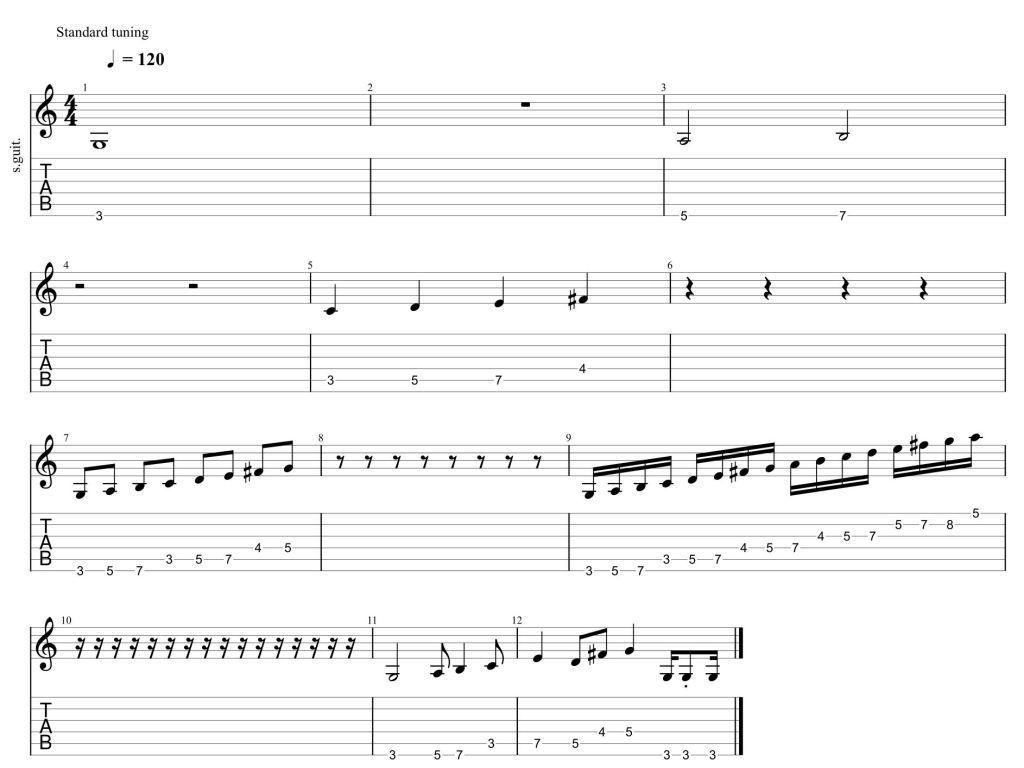
So you acknowledge there are letters symbolized on a grid, which is an oversimplified way of seeing notes in measures on a piece of music. The horizontal lines are bars that tell you which note to hit, and are then a part of a measure which is, in turn, part of the overall piece you are reading. You might get to remembering the notes/letters associated, it’s so easy, but that’s not all the information that is being displayed in a simple measure.
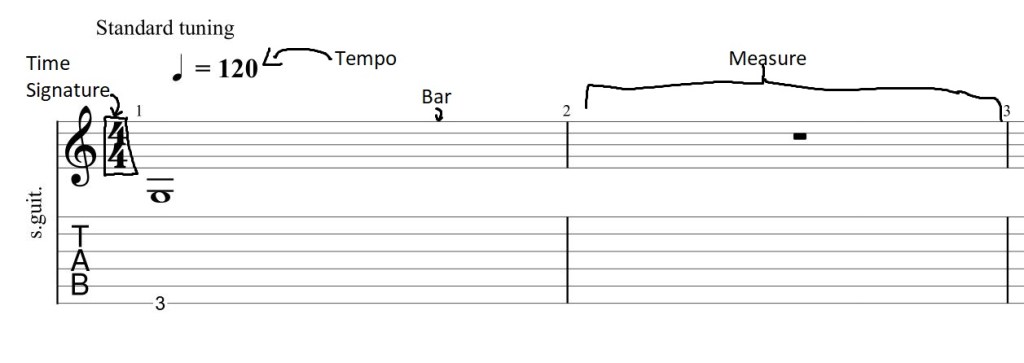
Time is also thrown in to let you know how long should the note ring out. There are whole notes, half notes, quarter notes, eighth notes, sixteenth notes, and further doublings until your hearts desires, though typically stops at thirty-second note. Once a line is thrown on the note (quarter notes) you can tell what value it is by the number of lines branching off the note to the right, the more lines, the quicker the time value of the note (one line = quarter, two lines = eighth, three lines = sixteenth and so on). Their measured lengths are relative to the Tempo established in the beginning of the piece. Tempo is measured in Beats Per Minute (BPM), it’s exactly as it sounds, the speed in which consistent quarter notes would continue until a minute. How ever many beats came out in a span of a minute is how many beats per minute there are to be expected in the piece. That’s why the tempo has a quarter note followed by an equal sign and the actual bpm. This piece was written around a 120 bpm tempo.
Now we’ll do some math, sucks but it’s important to understand this concept
1 Whole note = 2 Half (1/2) Notes = 4 Quarter (1/4) notes = 8 Eighth (1/8) notes = 16 Sixteenth (1/16) Notes
The pattern might be apparent, but the math comes in when you start to make a song. All quarter notes of the same note would be boring, unless you’re playing running with the devil (which makes it just the backing, nothing is boring when you know how to bring it together, like in this song), so you throw in variations to make it musical to your ears.
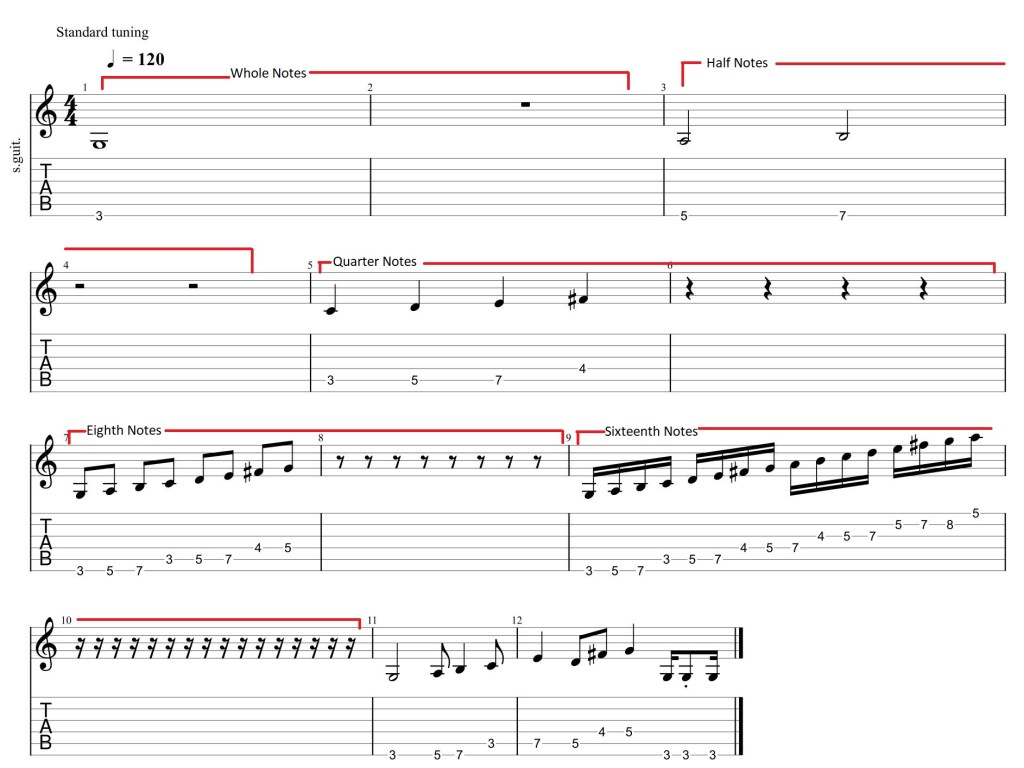
Those numbers from earlier can be seen in the image above. Those numbers mean how many of their own type can fill up a measure in 4/4 (this concept will be discussed in another post but, simplified, it means that 4 quarter notes fill a measure, if it was 3/4 then there would be 3 quarter notes to fill up a measure; can be overwhelming to grasp fully and, honestly, you don’t need to really) So the sixteenth notes need 16 notes to fill up a measure, and the quarter need 4. In the image I showed quarter notes and their respective breaks.
Notes say “hit this for this long”, breaks say “be quiet for this long”
What Does It Sound Like?
Here is a playthrough of what I wrote. I included the sound of a countdown and the metronome with the piece. The countdown is like when the drummer hits their sticks to make sure everyone is on the same page of speed (tempo), and the metronome is the consistent beat of quarter notes relative to the tempo. In the first measure, there is one note, but it rings out for 4 beats. You’ll notice it best when it gets to the quarter note portion, every click gets a note, then the eighth notes get 2 notes in within each click. How you get back on the click is what determines the rhythm.
Where does the Math Pop Up?
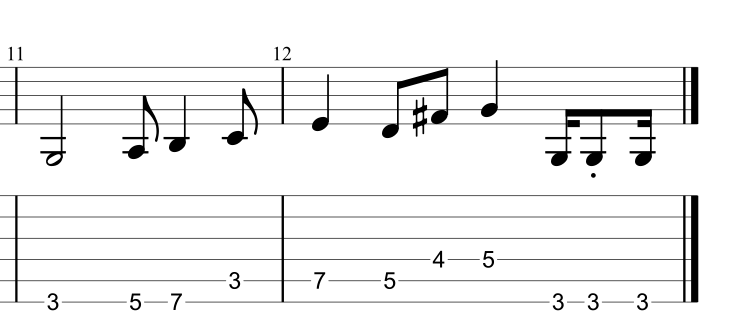
A good place to see where the math comes in is in the last 2 measures, 11-12. Before we get into it, we must remember that a measure should ALWAYS add up to a whole, like 2 halves equal a whole, 4 quarters are a whole and so on. In this specific example, I used half, quarter, eighth, and sixteenth notes together. Measure 11 has a half note (1/2), an eighth note (1/8), quarter note (1/4), and another eighth note (1/8). Getting the common denominator of 8, we get the following values, 4/8, 1/8, 2/8, and 1/8. Add them all up and you get the whole, 8/8, to get your measure “filled properly”. Using the understanding of the 11th measure, add up the 12th to see for yourself. The difference (aside from the pitch) is the lack of a half note and introduction of 2 sixteenth notes.
You may notice that there is a dot under the second to last note, that signifies a staccato. This can be thought of as a “quicker note”, it lets you know that there should be a minimization of playing legato (stringing the notes constantly without break (this concept and various playing styles will be brought up in a future post) a way to imagine is to read the following sentence in their 2 ways: “Howdy there buddy” vs “Howdy, There, Buddy” the first is more legato, while the second has the staccato stuttery type of speaking) The purpose of showing that is not to drill it specifically, but to expose you to symbols that could be shown throughout pieces that you will be working that tell you how to approach the note. Another example is the Fermata (𝄐) which just means to hold the note for as long as needed. Ever seen the conductor look like they’re building up the orchestra while they’re playing a single note (though different for each instrument)? The piece most likely has that symbol and they’re waiting for the conductor to give the ensemble the chance to release the note when the conductor says so. Though sometimes the long holds are properly defined, the one writing the music has unlimited options, and sometimes the conductor will take creative liberties and create tweaks.
Wanna try to Count it out yourself?
Here’s the same video with only the countdown and the notes themselves. Try counting it out with video
Also most of what I’ll share will be written in tab with standard notation elements showing note length, which will be discussed HERE
 Bodacious Music