
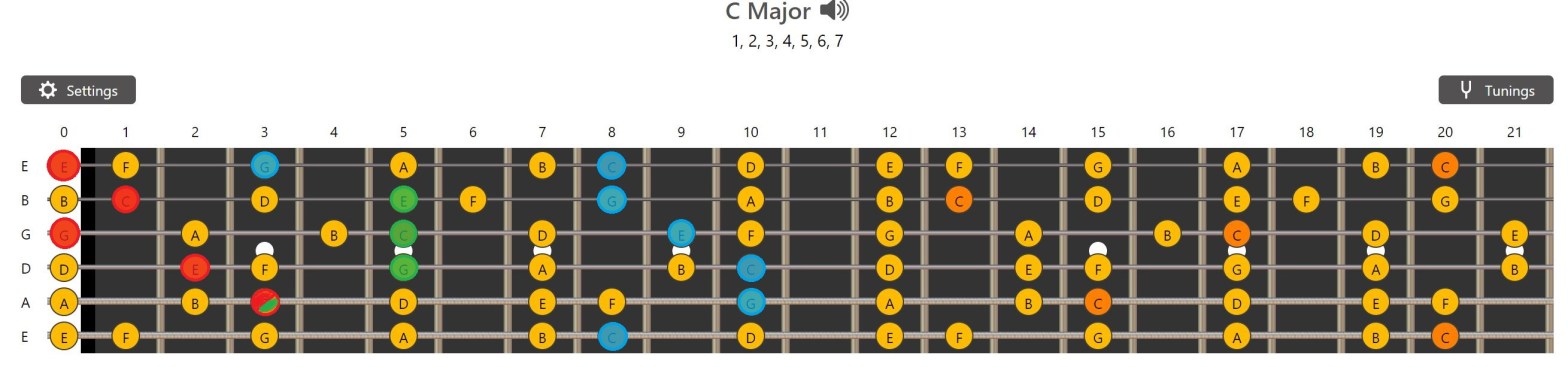
Preface: This will be a brief way to look at the connection between chords and scales on guitar. I have articles on Scales and Chords, going in depth in how they work and how they are read in charts. If these images seem confusing, you should read the pages before reading on to familiarize yourself with the concepts discussed here. You should also check out my article on the relationship much more in depth of this topic, which also brings up working with piano and the theory behind the relationships themselves. This, here, will be a rather simplified approach that may leave you with more questions. These articles will hopefully answer them for you, but for now, consider this a teaser.
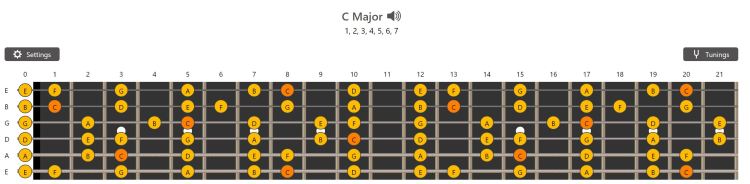
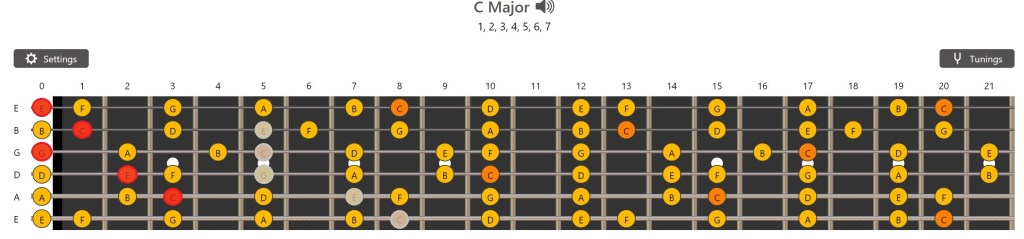
Up above we got the C major scale in all its glory and possibilities. Start from any position and end it where you want. It’s the map of all the streets and you have no GPS to weave you through specific patterns/routes. You choose how you create your route (chord), there are usually fancy names to identify that sound scary, you don’t need to know what it is, but how to use it.
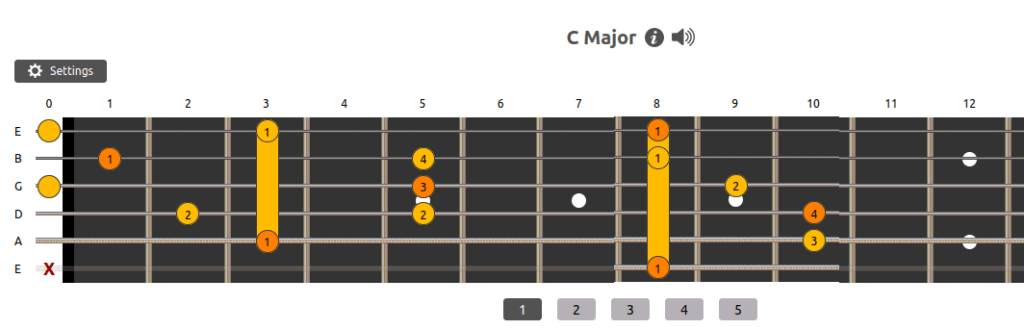
Then we have the C major chord expressed in 3 different variants, depending on where the root is located on the neck. Note that in shape 1 and 2 there is an overlap of the third fret, on the A string.
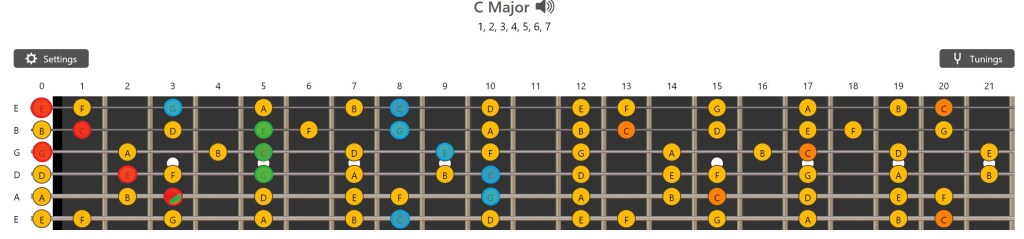
Now we have all 3 variants thrown in the major scale. All major shapes for chords will go over some spots of the major scale
Now here we rewrote the C major of position 1 to be built off the Low E string. Root of the position 1 chord is C4 (middle C) on the A string 5th string, while the C4 on the low E string is on the 8th fret. E4 on the D string then gets transformed to the 7th fret of the A string. From there we are trying to transform every note from different roots
 Bodacious Music