
So the title of the post may seem wordy and a little scary, but the visual connection a musician can make with the notes is to see the pattern of the lowest note to the highest. After A is A# then B and so on… on guitar there’s the idea that you can hit the same note in more than one place, the C4 you want to hit can be on the 8th fret of the low E string, or the 3rd fret of the A string. That concept can distort how you imagine notes, not knowing the instrument, you might think you’re higher up the neck, therefore the note should be higher. That idea isn’t translated perfectly on the guitar, but it is when thinking about the piano, only one key is the C4. If you want to hit the note, you have one option. Going one key to the left is a B, one to the right is C#. Go to the right to go up in pitch, and to the left to go down in pitch, it is an absolute rule when working with keys, whether a piano, a xylophone, marimba or even a kalimba. It’s simple and logical.
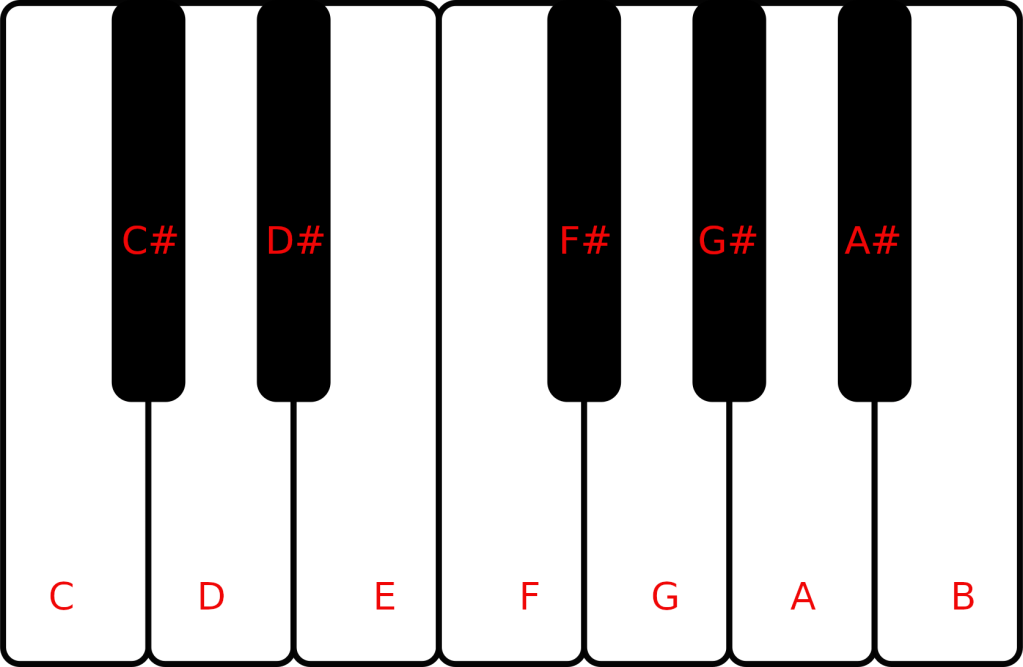
On guitar, your motions doesn’t equate to the same shift per change, move one fret up or down on the same string of the C4 (the first C on the low E string in the image below) and you’ll get B3 or C#4. However, moving up a string throws logic as you know it out. Now you’re hitting F4, that’s not how the twinkle twinkle alphabet song says sequential letters should be. Going up one should be “one more up” at first thought. When your amp says it goes to 11 instead of 10, how much louder is it? Well, it’s one more louder, and that’s great. In music, our unit of measurement is through steps. One half step from C is C#, one whole step is from C to D (can also be thought as 2 half steps, adding with fractions comes back!) With the simple math, 3 half steps away would be 3 keys offset from where your root is, while 2 whole steps would be 4 keys off.
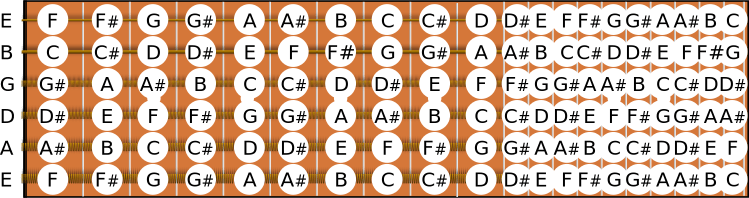
On guitar, going up a fret is a single step, but going up a string is equal to 5 steps up. (Generally, when talking about steps, the term “step” used on its own, like in the previous sentence, means a half step. I brought up the full term as “half step” to show the topic, but “steps” are generally how they’re called colloquially. When it’s specifically a “whole step” it’ll be clarified as such.) Going from the C on the Low E up a string gets you F on the A string. That same note is on the 13th fret of the low E string. A linear approach on guitar could be seen from a fret by fret basis, for now, through a single string. Later on in your musical journey, the whole of the image above will be second nature to you and you’ll be able to navigate the fretboard more fluidly through all your strings.
Too Much Guitar, Give Me Piano Stuff
That whole part before was just to show the nature of the note orientation and instrument relationship, and the pitfalls that can occur when trying to directly transfer over your musical understanding to the other instrument. I can already hear you through your screen that you wanted to see some piano chords and scales, well lets gets started…
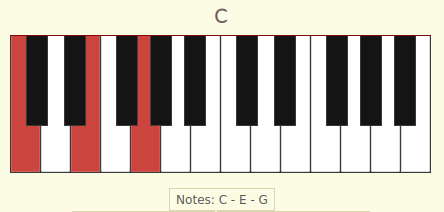
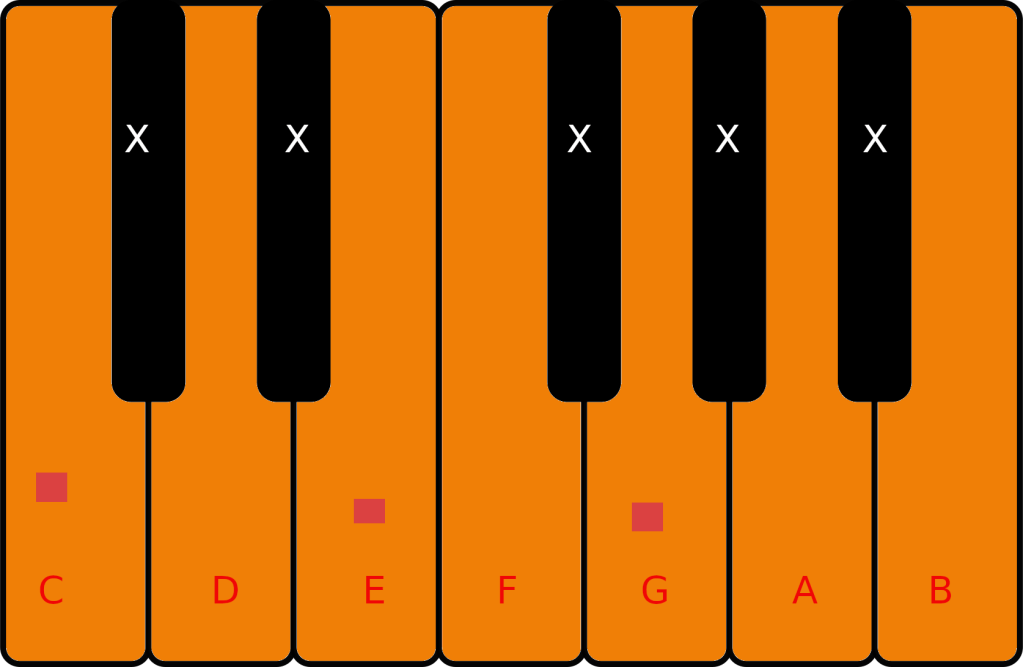
Above is your first chord. It’s a C Major chord. A chord can be defined as the playing of 2 or more notes at the same time on the same instrument (when it’s on different instruments it is a harmony.) This particular chord is defined by the notes listed below: C E G. The “Major pattern” has the root (C, usually the first most left (lowest) key of the chord), three keys offset (known as the major third in theory terms, and E in this case), and 7 keys from the root (2 from the second note) to give you the Perfect Fifth, G. I brought up fancy terms like the major third, and the perfect fifth. Those are terms to orient your playing to a certain defined key and create defined voicings that can be shared academically. The patient knows they hurt their arm, but the doctor knows they hurt their ulna, they note it on your record so the next doctor looking you over knows the issue. Sometimes you augment your chord and need someone you’re playing with to play that very chord; you’re on guitar and can’t just say “hit the 4th fret instead of the 6th” to someone playing a piano. Those technical terms help you tell other instruments what you are playing and what you have in mind for others to play. When you’re moving around the keys to hit another major chord, your hands must follow the pattern to be defined as a Major chord.
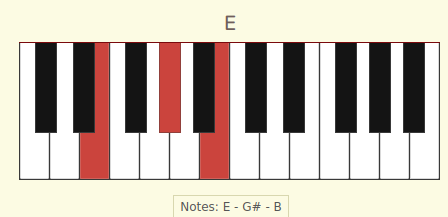
Above is another Major chord, but an E Major chord. It is made up of E G# and B. The way I brought up shapes and chords for guitar do not work the same way for piano, though the fundamental theory still applies. The shape here is built on the same foundation as the C Major: has the root (E), three keys offset from the root (G#), and 7 keys from the root (2 from the second note) to give you the Perfect Fifth, B.
Scales
So I’ve brought up chords, which are a group of notes, with a defined structure/voicing that are played simultaneously. Scales, on the other hand, are a group of notes that are played sequentially.
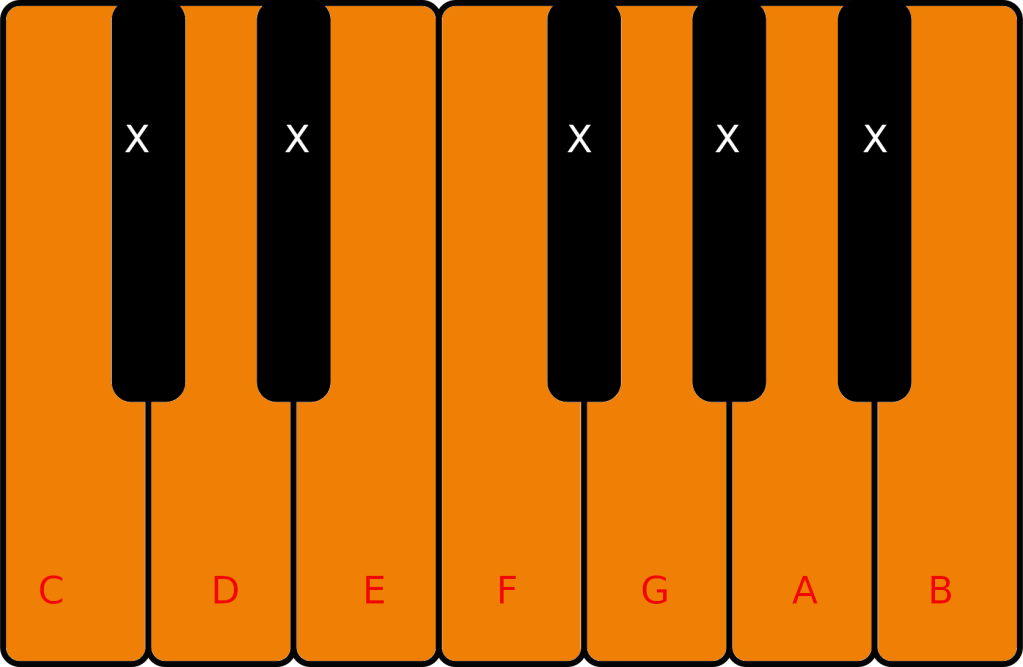
The Orange keys are played, while the X’s are skipped over. The C major will always comprise of C D E F G A B, no sharps in C Major. The pattern behind the notes is: from the root you go 2 steps/keys over to D, another 2 steps/keys to E, 1 step/key to F, 2 steps/keys to G, 2 steps/keys to A, and 2 more steps/keys to B before hitting the next octave C to start the scale for the next octave. This pattern means you can swipe your hand on all the white keys and you’ll be playing C Major!
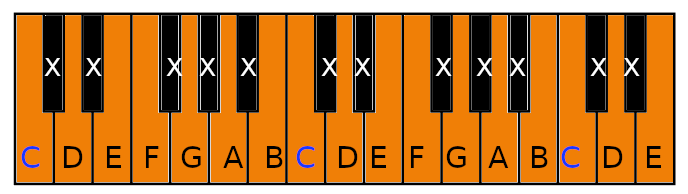
The above is how to push the C major beyond the same range to use more of the keys. The scale is a cycle and is being repeated each time you hit the C again. Each C you hit is in a different octave and the start of the rest of the scale in that different octave, with the same pattern.
What’s the Relationship?
So we went pretty deep into what makes chords and scales the scales and chords they are, but what’s the relationship??? It’s a pretty simple but powerful truth in music theory. They are both defined in their own terms that make them unique, but only one fits in the other. The main point is that the pattern of major chord leads to notes that fall within the major scale. Fall out of the pattern and it won’t be a major, though there are some overlaps in structure with other chords in different voicings. The circle of fifths gives a good intro of chord pairings, which will be discussed more in depth in the future. This is the connection of relative minors. As a little teaser, the A minor scale looks very familiar, what the heck?
Think about scales as a dictionary with a set number of terms. The limit of the terms dictate what can be in sentences. The words can be arranged in any way, be abstract and a seemingly weird phrasing makes perfect sense in the context (the phrase “..and that’s why clown shoes saved my life” needs context), or be predictable and stable on its own (the phrase “the floor is beneath me” is always true.) The words are notes, with sentences being how the notes are strung together. Sometimes creating a limerick has you thinking weird words that don’t make sense since your focus might be on the rhyme scheme. The confidence to hit a “sour note” lets you explore ideas. Your goal is to create, and sometimes having some core limitation to base a starting point off of can help you start some exploration in musical ideas
Do you build to solid structure like a skyscraper with rigid corners towering all the way up, or build to the organic environment with shapes that may not follow a ruler all the way through? Your approach to the shapes you see define you as a creator and musician.
Shapes? Shapes? Shapes?
Here the shape isn’t visual, but a theoretical shape. I call it a shape, but it’s the pattern for chord or scale type. The shape doesn’t pop up as consistent like on guitar, but the theory behind it is the shape/pattern that defines the chord or scale.
Major “Shape”
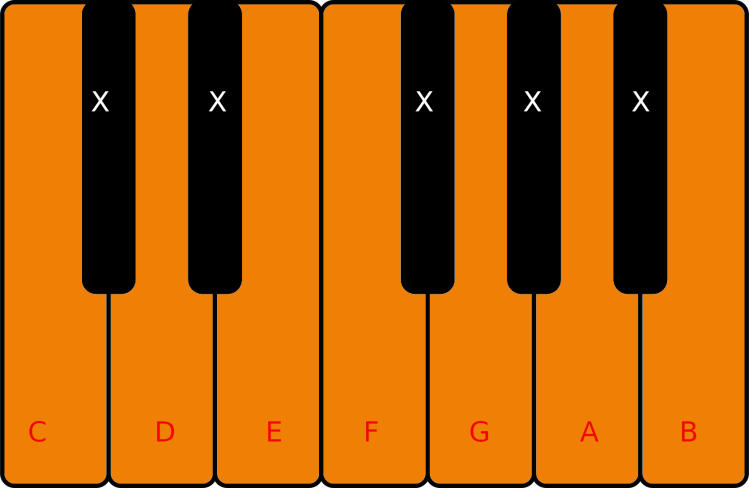
Scale: from the root you go 2 steps/keys over, another 2 steps/keys, 1 step/key, 2 steps/keys, 2 steps/keys, and 2 more steps/keys before hitting the next octave root to start the scale for the next passage
Chord: has the root, three keys offset from the root, and 7 keys from the root (2 from the second note) to give you the Perfect Fifth.
Both of them Together
Seeing it In Another Scale and Chord
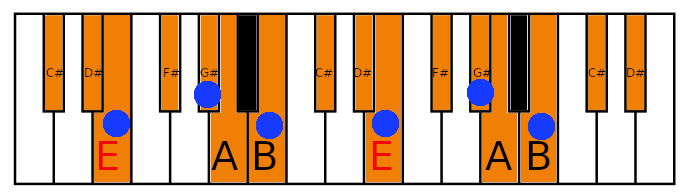
Up above is an E major scale with the chord shape laid out. The same notes are used in different positions, since that is what defined the chord as such. Piano keys just repeat the 12 keys for each octave range, the form remains the same in their respective octaves.
Chords in Words
Look at them chords
E Major: has the root (E), three keys offset from the root (G#), and 7 keys from the root (2 from the second note) to give you the Perfect Fifth (B).
C Major: has the root (C), three keys offset from the root (E), and 7 keys from the root (2 from the second note) to give you the Perfect Fifth (G).
How about them Scales
E Major: from the root (E) you go 2 steps/keys over (F#), another 2 steps/keys (G#), 1 step/key (A), 2 steps/keys (B), 2 steps/keys (C#), and 2 more steps/keys (D#) before hitting the next octave (E) root to start the scale for the next passage
C Major: from the root (C) you go 2 steps/keys over (D), another 2 steps/keys (E), 1 step/key (F), 2 steps/keys (G), 2 steps/keys (A), and 2 more steps/keys (B) before hitting the next octave (C) root to start the scale for the next passage
Review
In the end I want to really instill the idea that chord and scales follow forms that define them as such. You can modify any chord however you want, but it may no longer be a major chord. Definitions are absolute, but, just like words, you sometimes make some shiznit that ain’t “real words.” Even though there are “rules”, you have the freedom to change what you see to what you want to hear. If you make up a word with no relatable root then it’s nonsense like a zoopity toop, but you may recognize the word shiznit is going around. Those tweaks are how you can approach your “chordal tendencies” (another word I made up (I think)) and their roots, but it shows to not fear making nonsense, so long as there’s something keeping it rooted. When you get comfortable, you’ll be able to make nonsense that needs context that you fill in yourself, which is really what makes a composition complete. You’re making a new language, as crazy as it is, as long as you define patterns and rules you can make your own nonsensical language, will anyone understand? Nah, but you made it. There is a difference between avant garde and just plain chaos, it’s a thin line, but soon you’ll have fun riding the tightrope between the 2 on a engine powered unicycle over a shark tank with lasers.
 Bodacious Music
3 thoughts on “Chords and Scales With Linear View (AKA Scales and Chords for Piano)”